Presentation details
Event: 2026 Health Data Science and AI Showcase at Boston University.
Date and time: September 15, 2026, 12:00 to 2:00 PM.
Location: Hiebert Lounge, 72 E. Concord St., Boston, MA.
Two common significance tests passed on the cohort containing no biology in 10 of 10 random seeds.
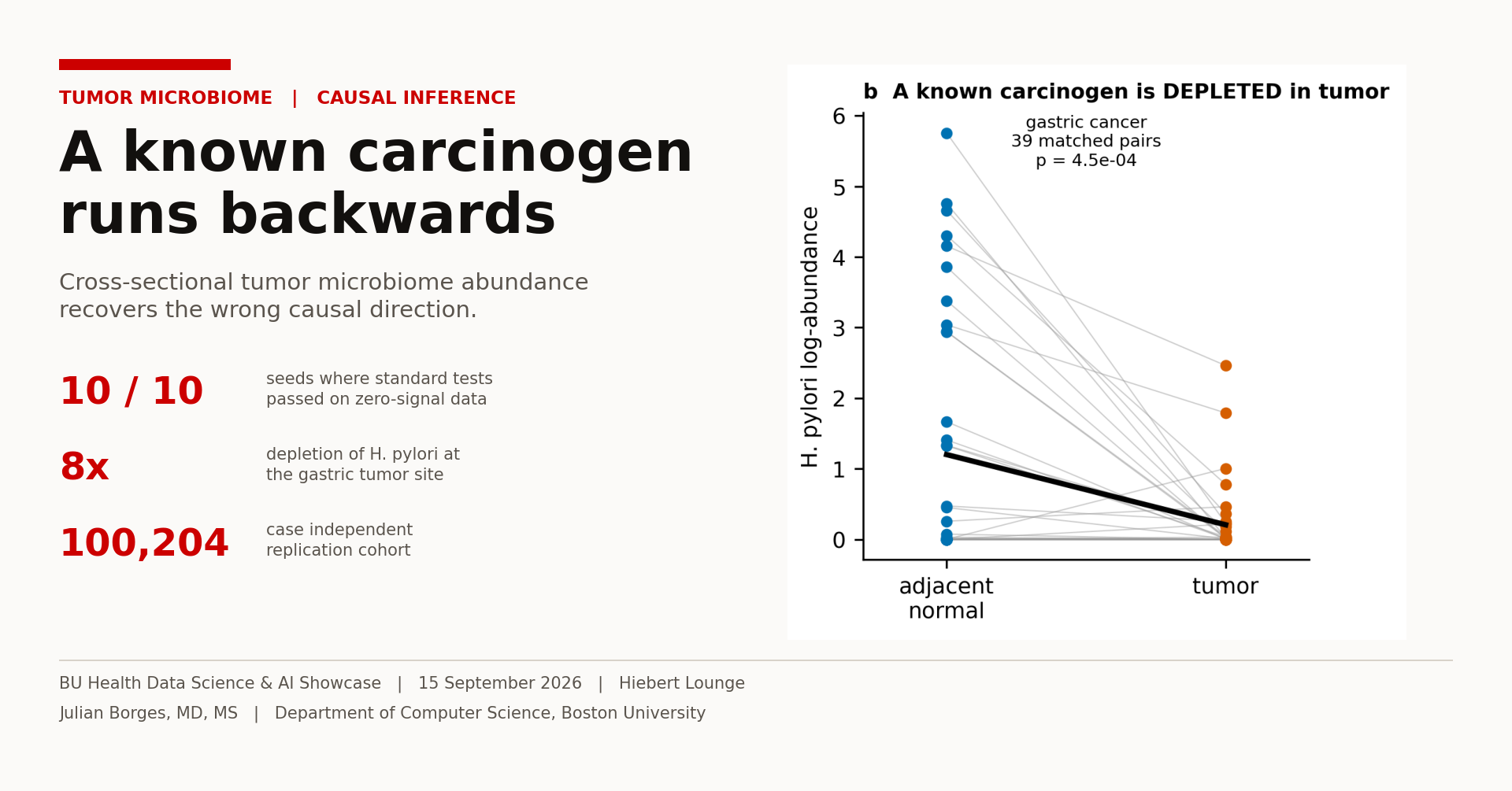
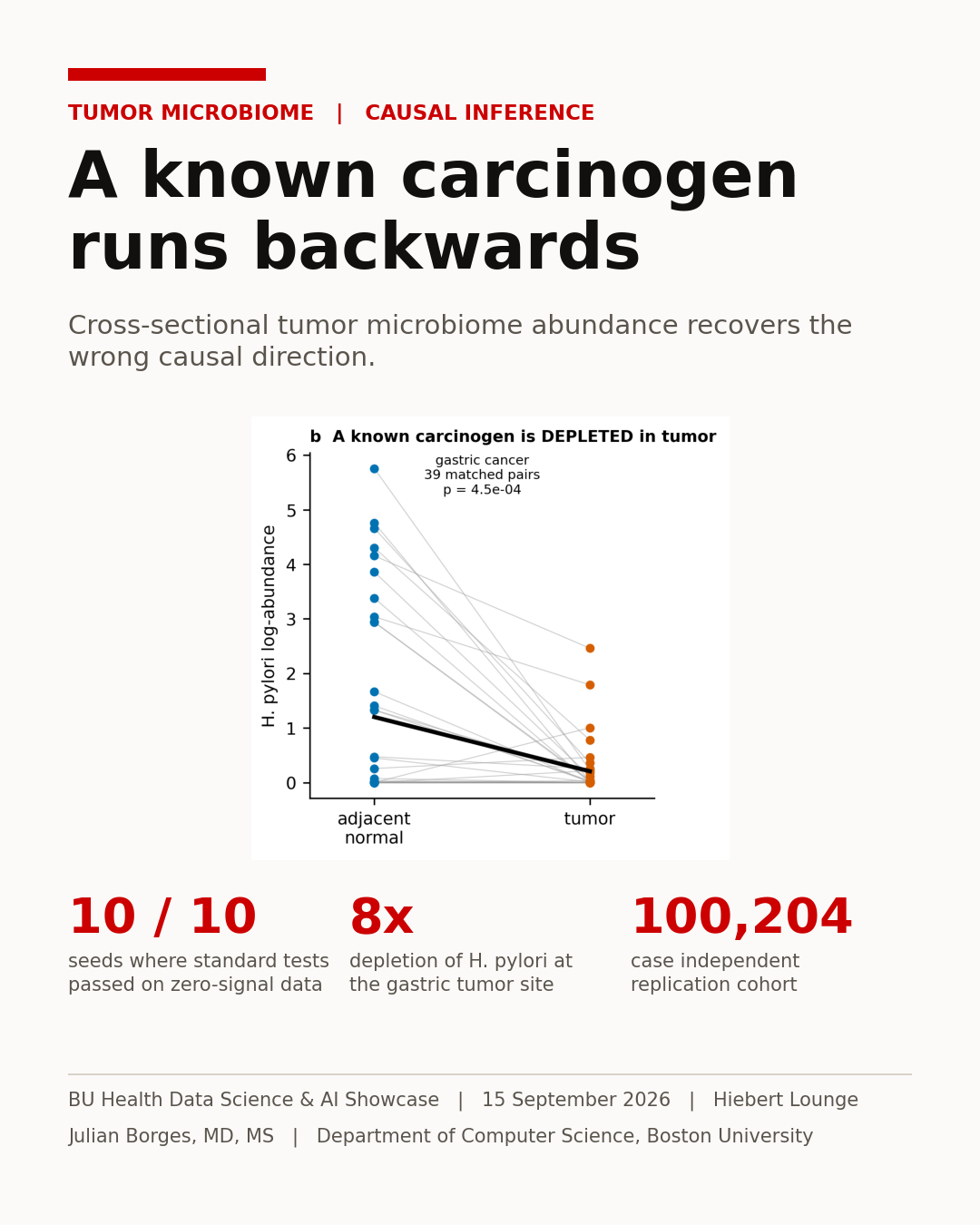
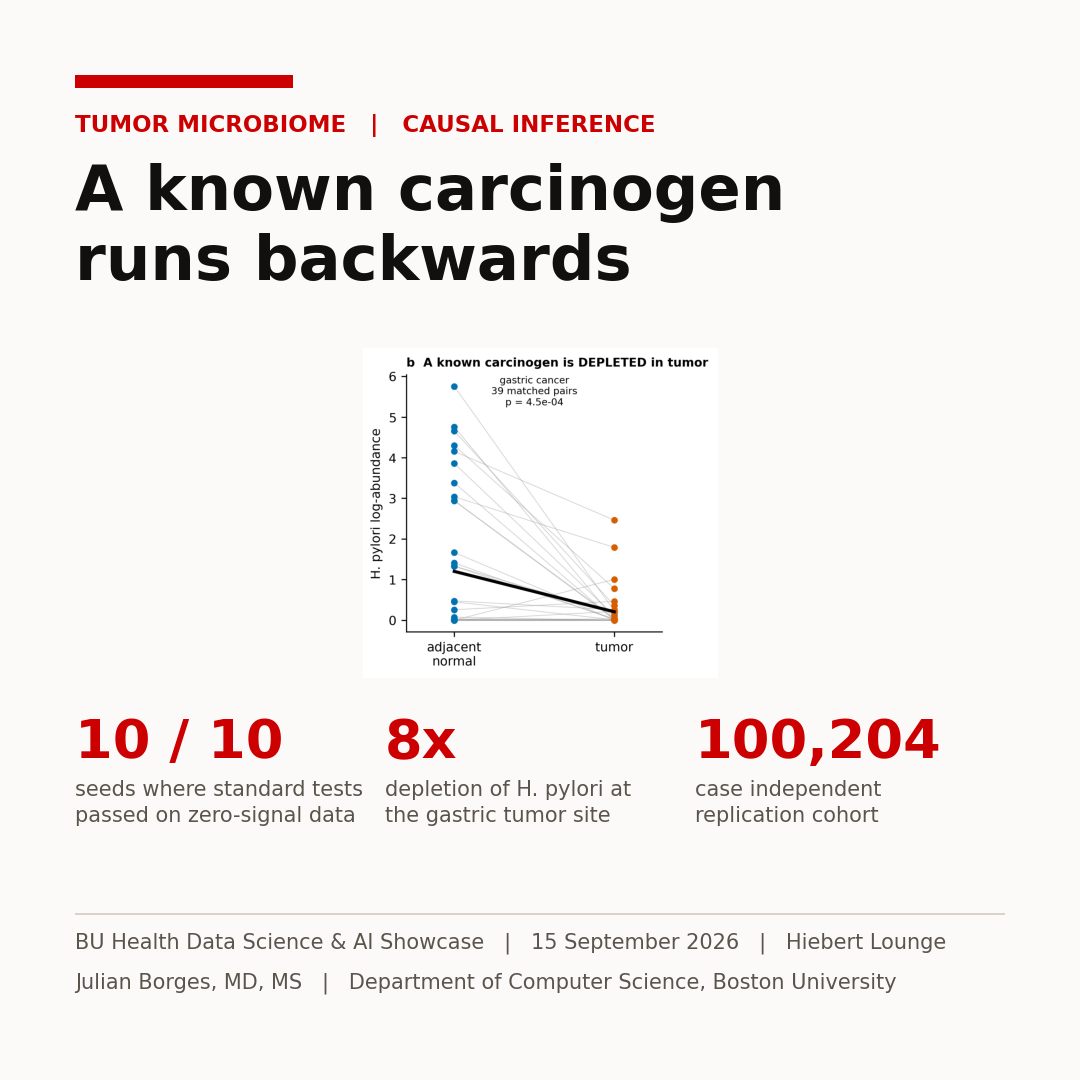
The known IARC Group 1 carcinogen was roughly 8-fold depleted at the tumor site across matched gastric pairs.
Mendelian randomization found no corrected single taxon, but cross-cohort directional agreement reached 61.4 percent.
The post
A public-facing summary of the abstract, formatted for the FxMEDBR research blog.
A known carcinogen ran backwards. That is when I knew the method was the problem.
I will be presenting at the 2026 Health Data Science and AI Showcase at Boston University on September 15.
The tumor microbiome field spent the last two years building decontamination pipelines, and rightly so. But decontamination answers only one question: is this microbe really here? It does not answer the second one: is it causal, and in which direction?
So I ran a calibration study.
First, ground truth. I built two synthetic cohorts, one with real biological signal and one with none. The two significance tests most commonly reported in this literature both passed on the cohort containing no biology, in 10 out of 10 random seeds. Only a confounder baseline and within-batch cross-validation could tell the two apart. Batch confounding alone manufactured accuracy 2.5x above chance from nothing.
Then, a natural control. Helicobacter pylori is an IARC Group 1 carcinogen and the accepted cause of gastric adenocarcinoma. In a decontaminated reference cohort it is roughly 8-fold depleted at the tumor site across 39 patient-matched pairs. For the one organism whose causal role we independently know, cross-sectional abundance gives the wrong direction.
The mechanism is not mysterious. Gastric carcinogenesis destroys the acid-adapted mucosa the organism needs. It causes the disease and is then displaced by it.
So I moved to germline anchoring. Mendelian randomization of 211 gut taxa, replicated in an independent cohort of 100,204 colorectal cancer cases. No taxon survived correction. But directional agreement between the two cohorts reached 61.4 percent against 50 percent expected under noise, which suggests the causal signal is real and diffuse rather than absent.
All code versioned, seeded, checksummed, assertion-checked.
If you work on microbiome, causal inference, or cancer epidemiology, come find me at Hiebert Lounge on the 15th. I would genuinely like to be argued with.
Research communication for academic discussion. This post does not provide clinical advice, diagnosis, or individual medical recommendations.